Fifteen minutes from ignition to splashdown — built on our simulation data
There is a moment, about two minutes into the simulation below, where the rocket has shut down its engine and the capsule continues to climb in complete silence — and what you see through the window is no longer sky. It is the curvature of the Earth, stretched out beneath a thin blue strip of atmosphere, and everything down there is very, very far away.
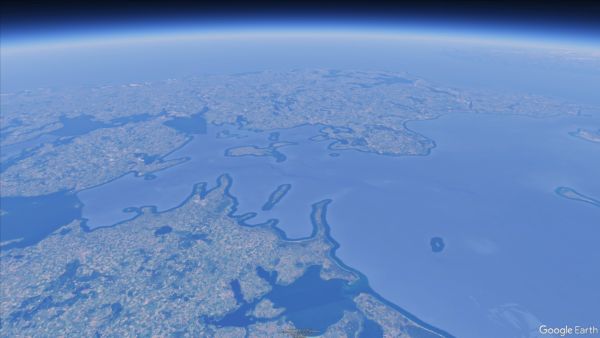
We have seen that moment many times. Every single time, you can feel it in your chest.
We have built a full flight simulation. From launch right here at our workshop in Copenhagen, through all the phases — ignition, powered ascent, MECO, free fall, apogee, re-entry, parachute deployment, splashdown. About 15 minutes from first fire to the capsule floating. Speed, g-forces, and timestamps on the screen are taken directly from one of our simulations. It is not artistic license. It is one of the possible mission profiles.
Watch it first. Then we will walk through it.
You can see it normal mode here:
Or in a 360 degree version here:
Why we launch from Copenhagen in the simulation
The first thing you notice is, of course, that we launch from our workshop on Refshaleøen.
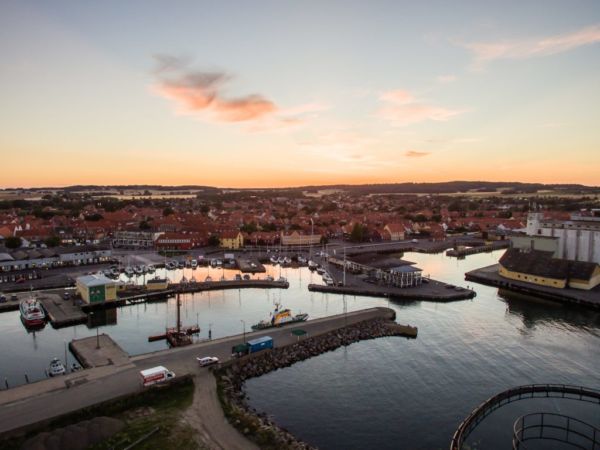
That is not where the actual launch will take place. Our real launch site is in the Baltic Sea, 30 kilometres east of Bornholm — deliberately chosen far from air traffic, shipping lanes, and populated areas. You can actually see the site in the simulation as you get high enough.
But I have made a deliberate choice to start from here, and I want to explain why.
Something happens in the first ninety seconds of this simulation that no graph has ever been able to show. You see the rocket climb, and you see the streets of Copenhagen getting smaller. You know them. The harbour. The rooftops. The shape of the coastline you have cycled along. And then it is all gone in a few seconds — not gone the way it is when you take off in a plane, but gone, swallowed by a landscape that is now all of Zealand spread out below. A few more seconds, and you can see all the way to Bornholm to the east and Jutland to the west. And then, incredibly quickly, Norway.
We wanted the people who have followed us — especially those in Copenhagen, those who walk past our workshop and have seen this project grow from a strange idea into a working rocket programme — to feel the scale of what we are attempting in a way that is personal to them. Not abstract kilometres and altitude figures. Their city. Their country. Shrunk to a miniature in under two minutes.
This is what it will look like to travel into space. I just thought it should be shown from a place you know.
What you see
The data overlays in the simulation reflect our best current estimates for the Spica mission. Speed is shown in km/h. G-force reflects the load on the astronaut. The clock counts from ignition. The view is what the astronaut will see from inside the capsule during the various phases — if the window is large enough.
We built this because we wanted to feel it — not just calculate it. There is a difference between a number in a spreadsheet and seeing the horizon tilt as the rocket climbs. We wanted to show that difference to those who have supported us, and to those hearing about us for the first time.
The flight, step by step
Launch sequence — T-0
The launch does not happen in a single moment. Before ignition, the team goes through a detailed countdown procedure, the astronaut takes a seat in the capsule, the fuel tanks are pressurised, final checks of the flight computer are completed. The rocket stands on the pad. Everything has been pointing towards this moment for years. Then the engine ignites.
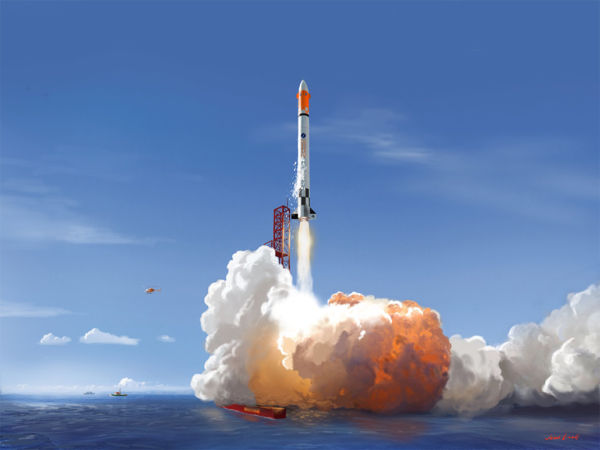
At ignition, the Spica engines produce up to 125 kN of thrust. For a brief moment, the rocket is still held down — a deliberate delay that gives the engines time to build full thrust and confirm stable operation before it is released. When the rocket is let go, there is no turning back.
Powered ascent — T+0 to T+[~90s]
The first phase is fast. The rocket accelerates, and you see it forcing its way through the lower atmosphere. The astronaut is pressed down into the seat.
During this phase, fins and our active guidance system work together to keep the rocket stable and on course. This is where we can make small trajectory corrections — more on that below. The ascent profile is designed to minimise structural loads on the rocket while reaching our target altitude: not a vertical path, but a carefully shaped arc to keep us within the safety zone.
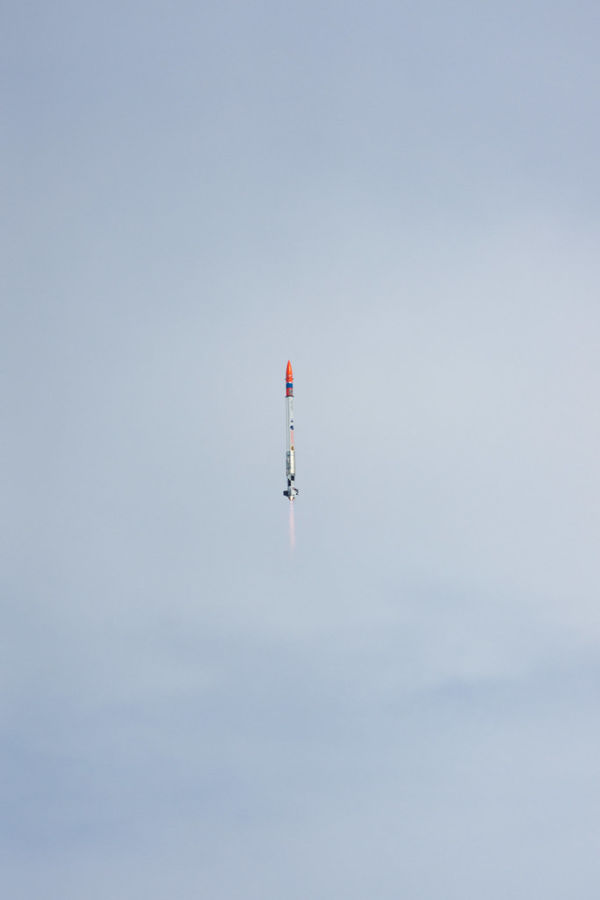
The atmosphere works against us here too. As the rocket accelerates through denser air, aerodynamic drag is significant.
MECO — Main Engine Cut Off — T+[~90s]
When the fuel is spent, the engine shuts down.
At MECO, the capsule is travelling at approximately 3,750 km/h — roughly three times the speed of sound — and is at an altitude of about 50 km. It has not yet reached space. But the engines do not need to burn any more. Inertia carries it the rest of the way up.
This moment is one of the most fascinating in the entire flight. The astronaut goes from high g-loading to near weightlessness in a split second. The engine is done. Physics and Newton take over.
Separation and coast phase — T+[~100s] to T+[~2–3 min]
Shortly after MECO, the capsule separates from the rocket booster. The two units are now independent. The booster follows its own ballistic trajectory; the capsule continues to climb in silence.
The coast phase is where the simulation opens up visually. The atmosphere has effectively ceased — no significant air resistance, no sound. The capsule is in free fall upward, which is a strange sentence to write, but it is precisely what is happening. The astronaut is weightless. The view outside is unlike anything a human normally has access to — except for a small select few people in history.
The coast phase to apogee lasts a couple of minutes. There is nothing to do but enjoy the view.
Apogee — T+[~4–5 min] — approx. 105 km altitude
The Kármán line — the internationally recognised boundary of space — is at 100 km. Our mission profile is designed to cross it and reach 105 km. At apogee, the capsule is momentarily stationary on the vertical axis: it has stopped climbing and has not yet begun to fall. It is the highest point. It is space.
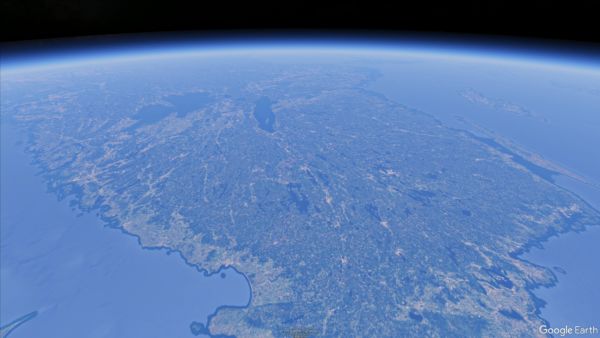
In the simulation, you sense how far the Earth is below. The sky above is black. The thin atmosphere is visible as a narrow, incredibly fragile blue band. A group of people built this capsule and got us up here.
Re-entry and drogue parachute — T+[~4–8 min]
The capsule begins its descent. Gravity is persistent. As the capsule returns to the upper atmosphere, air resistance begins to build again — gently at first, then more aggressively as the air thickens. The heat shield on the bottom handles the thermal load.
At a preset altitude of approximately 70 km, the first drogue parachute is deployed. It is small and designed to be stable at very high speeds — not designed to slow the capsule to landing speed, but to stabilise it. Without it, the capsule could oscillate or tumble during the chaotic middle descent phase. With it, the capsule is correctly oriented and decelerating in a controlled manner, ready for the next drogue parachute and the main parachutes.
Main parachutes — T+[~8–15 min]
At approximately 4 km altitude, the main parachutes are deployed. This is the moment the astronaut has been looking forward to since the engine shut down. The capsule goes from hundreds of metres per second to a manageable terminal velocity — approximately 9 m/s at splashdown.
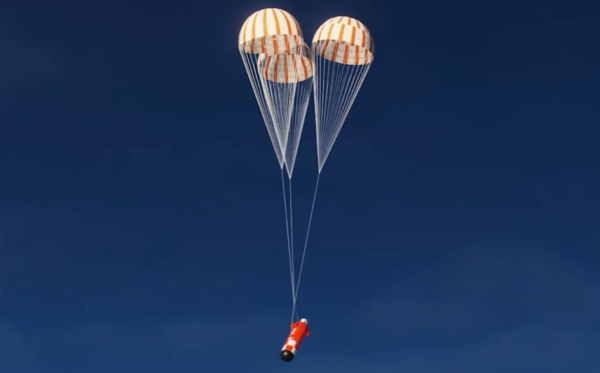
The main parachute phase is long — several minutes of slow, quiet descent. The motion is pendulum-like: the capsule swings gently beneath the many square metres of nylon. The angle is not vertical. The astronaut leans back and looks almost straight up at the parachute, while the sea slowly approaches below.
I know what that angle feels like. More on that in a moment.
Splashdown — T+[~15:06]
The capsule hits the water at approximately 9 m/s — hard, but survivable. That is equivalent to jumping into the water from about 4 metres. The simulation ends here. In reality, this is where the recovery team takes over.
Fifteen minutes and six seconds. From start — press the green button — to landing, with space in between.
How we actually steer it
One of the questions we regularly get: how do you steer a rocket flying straight up? The answer is that guidance is one of many difficult engineering problems we have been working on.
During the powered ascent, Spica uses an active guidance system, built entirely in-house. The flight computer reads data in real time and makes continuous small corrections to keep the rocket on its planned trajectory. It does this by angling the engines, which changes the direction of thrust and thereby steers the rocket.
The fins on the lower part of the rocket provide passive aerodynamic stability — they want the rocket to point into the airflow, like the feathers on an arrow. But fins alone are not enough; they only work as long as there is air to push against, and they cannot correct the types of disturbances the guidance system must handle.
After MECO and separation, there is no active guidance of the capsule’s trajectory. The flight is ballistic — the capsule follows the arc that physics gives it. The guidance system’s job is done. Everything from apogee onward to landing is managed by the parachute system: two drogue parachutes, then main parachutes, then splashdown. The astronaut has some manual capability to operate the parachute system, but the baseline is that everything happens automatically.
The capsule, tilted
Some time ago, I climbed into the capsule mockup. We tilted it to the angle the astronaut will actually sit at during descent under the main parachutes — the real angle, based on the real flight geometry.
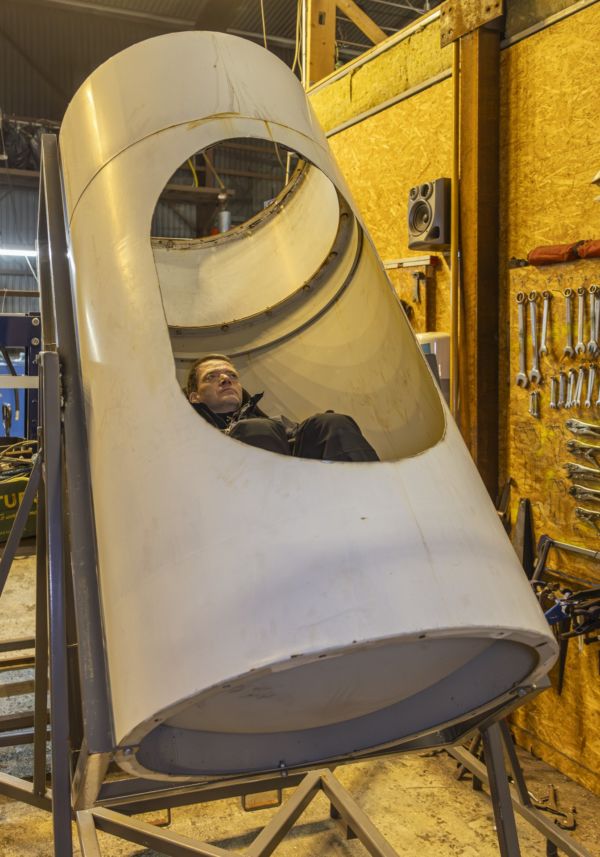
It feels steeper than you expect. You lean well back, and it actually ends up feeling very comfortable. The capsule is small. The walls are close. And sitting there, at that angle, it became very concrete in a way it does not always when you otherwise move around the capsule in the workshop. This small space has to keep a human being alive on the way out to space and back again.
I found it hard to put into words what I was feeling — the combination of pride in what we have achieved, and a very clear sense of how much is still required to reach the goal. Both things were present at the same time. I think that is the true feeling of being part of this project.
What we are working towards
Copenhagen Suborbitals is the only volunteer-driven nonprofit organisation in the world actively working to send an amateur astronaut into space. No government budget. No billionaire founder. We do it in an abandoned shipyard in Copenhagen, in our spare time, with money donated by people who believe that spaceflight should not require a fortune to participate in.
The simulation above is not a promise of a timeline. We know better than that. Rocket science is hard in ways that accumulate. Every system we solve reveals new questions, and that is as true now as it was on day one. A project like ours also makes clear how much infrastructure must be built just to be able to work on the rockets themselves.
The simulation is a commitment. A detailed, technically grounded statement of what we are trying to do, and what we expect we can achieve.
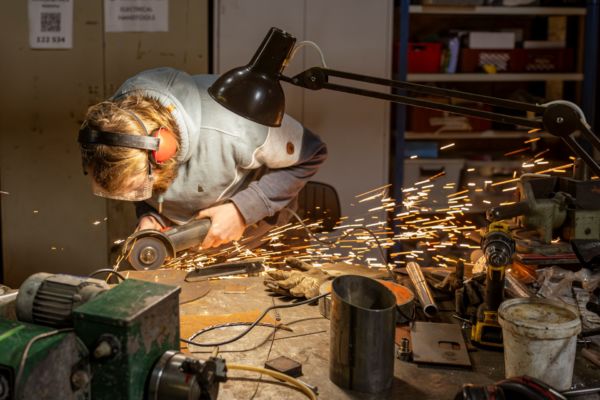
Every weld seam in the capsule, every hour in front of the sewing machine, every engine test on Refshaleøen — it all points towards the same fifteen minutes. One of us is going to sit in that seat.
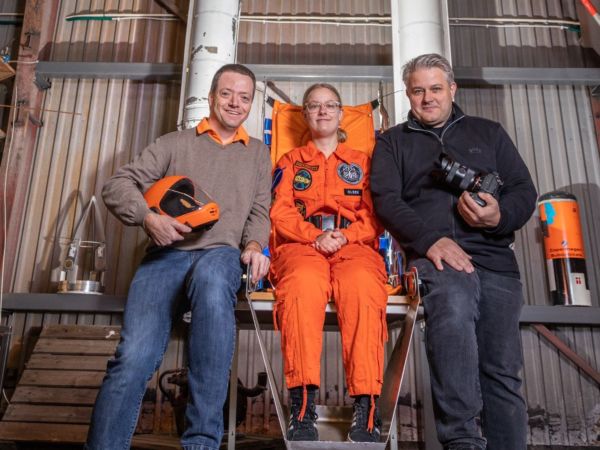
The rocket is going to ignite. And somewhere above the atmosphere, for a few minutes, the view through the window will be exactly what the simulation shows.
We will get there.
If you find the project worth supporting, you can read more here: Support Us